The Art of Scent: A Gentleman’s Guide
Discover the best men’s fragrances and designer colognes that define the modern gentleman’s signature scent profile. This guide explores premium fragrance notes, ranging from fresh aquatic aromatics to deep woody ouds, to help you find the perfect long-lasting Eau de Parfum. Elevate your grooming routine with expert tips on scent longevity, sillage, and choosing the top-rated perfumes for every occasion.
A Complete Guide to Men’s Fragrance
Most men have never been taught how fragrance actually works. They pick up a bottle, spray it on their wrist in the shop, decide they like it, and buy it. Six months later the bottle sits mostly unused because it smells nothing like they remembered. This is not bad luck. It is a gap in knowledge that nobody ever bothered to fill.
What fragrance actually is
Every fragrance unfolds in three stages. Fragrance is a solution. Aromatic compounds, natural extracts, synthetic molecules, or both, dissolved in alcohol and water. When you spray it on your skin, the alcohol evaporates and releases those compounds into the air. What you smell is not the spray itself but those compounds reacting with heat, moisture and the particular chemistry of your skin.
This matters because fragrance is not static. It is a process. What you smell in the first thirty seconds is not what you will smell in an hour. A fragrance that opens with sharp citrus might settle into something dry and woody by mid-afternoon and finish the day as a quiet, skin-close musk. That journey is the point. Understanding it changes how you buy, how you wear, and how you experience fragrance entirely.
Top, heart and base notes
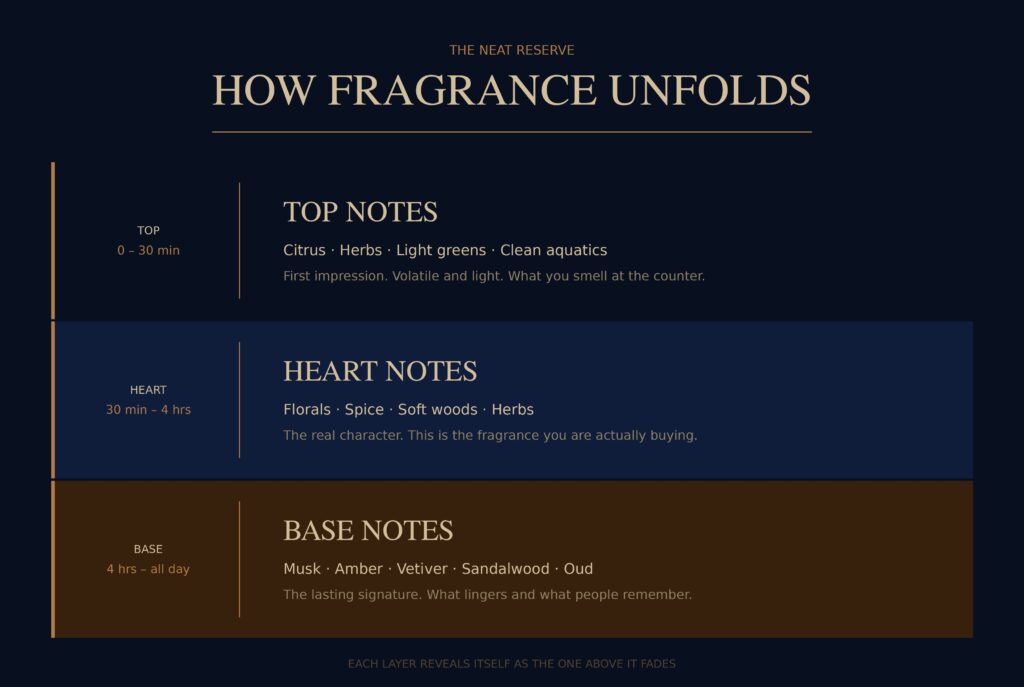
Top notes are the opening. Light, fresh, volatile. Citrus, herbs, clean greens. They evaporate within twenty to thirty minutes, which is why smelling a fragrance on a card in a shop tells you almost nothing. What you are smelling on that card is not what you will be wearing at three in the afternoon.
Heart notes emerge as the top notes fade. These define the real personality of the fragrance. Florals, spices, soft woods. They last between thirty minutes and several hours and are the reason two people can wear the same fragrance and have it read completely differently on each of them.
Base notes are the foundation. The heaviest, richest ingredients that emerge last and linger longest. Musk, amber, vetiver, sandalwood, oud. A well-chosen base is what makes a fragrance memorable. It is also what makes it smell different on your skin than on someone else’s. The base interacts with your skin chemistry in a way nothing else in the composition does.
Concentration
When you see EDT, EDP or Parfum on a bottle, you are looking at the concentration of aromatic compounds in the solution. Higher concentration means more fragrance oil and less alcohol. Stronger projection, longer longevity and a higher price.
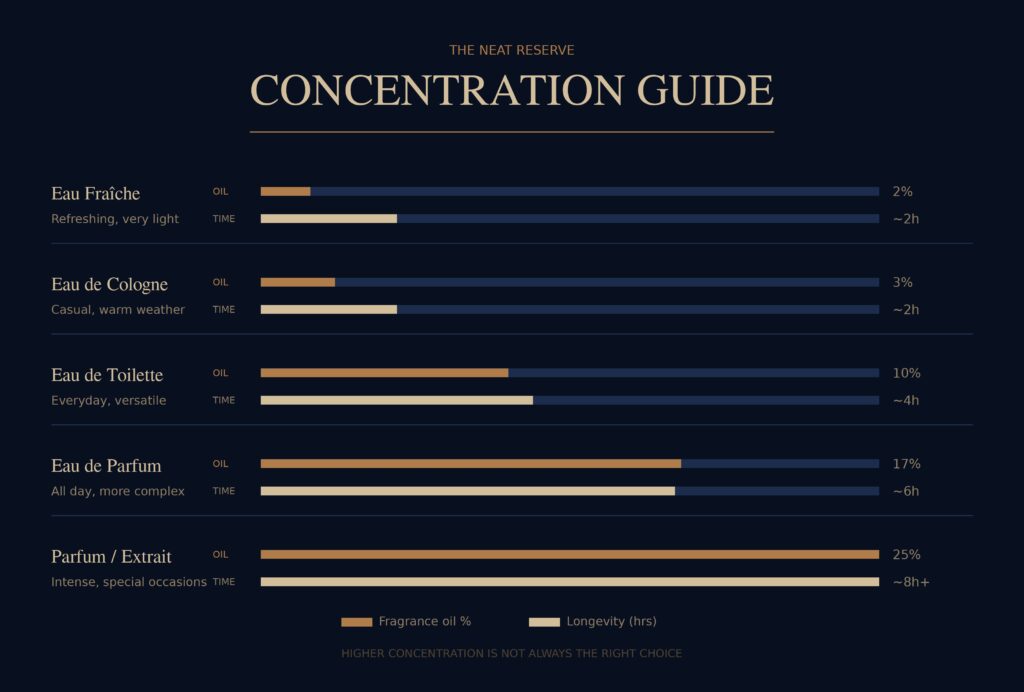
The categories from lightest to most concentrated:
Eau Fraîche sits at roughly one to three percent. A whisper of scent that lasts an hour or two at most. Useful for warm weather when you want the faintest trace of something rather than a statement.
Eau de Cologne runs two to four percent. The original format, long associated with men’s fragrance. Light, fresh, designed to be applied generously and reapplied throughout the day.
Eau de Toilette sits between five and fifteen percent. The most common format for men’s fragrance. Versatile, suited to everyday wear, typically lasting three to five hours depending on the formulation and your skin.
Eau de Parfum runs fifteen to twenty percent. More depth, more longevity, more complexity. The same fragrance in EDP will often reveal different facets to the EDT. Bleu de Chanel EDP is not simply a stronger version of the EDT. It is a different fragrance built around the same DNA.
Parfum, also called Extrait de Parfum, sits at twenty percent and above. The most concentrated and most expensive format. A single application can last all day. Applied sparingly, it sits close to the skin and reveals itself slowly to those nearby rather than projecting into a room.
Higher concentration is not always the right choice. An EDP in a hot Australian summer can be suffocating. An EDT in a closed, air-conditioned office can vanish by mid-morning. The right concentration depends on the occasion, the season and the environment.
Fragrance families
Every fragrance belongs to a family. These are broad categories that describe the overall character of a scent. Knowing them helps you understand what you already like and find new fragrances more efficiently.
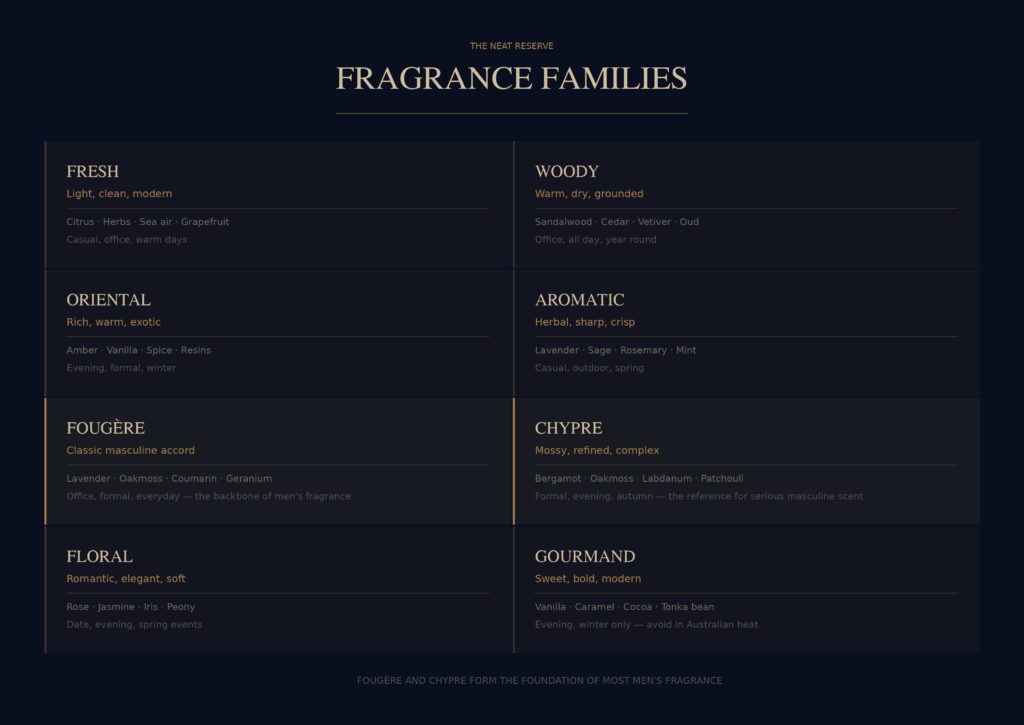
Two families are worth understanding in particular depth because they form the foundation of almost everything in men’s fragrance.
Fougère, pronounced foo-ZHAIR, is French for fern. It is the structural blueprint of most traditional men’s fragrances. Built on a classic accord of lavender, oakmoss and coumarin, a warm hay-like synthetic molecule, virtually every major men’s cologne from the 1970s through the 1990s is a Fougère. Brut. Fahrenheit. Drakkar Noir. When someone who knows nothing about fragrance tries to describe what cologne smells like, they are almost always describing a Fougère.
Chypre, pronounced SHEE-pruh, is the French name for Cyprus where the family originated. Built on bergamot, labdanum and oakmoss, it is oakier, earthier and considerably more complex than a Fougère. It became synonymous with luxury and refinement through the mid-twentieth century and remains the reference point for serious masculine scent. If Fougère is the workhorse, Chypre is the gentleman.
How to apply fragrance
The mechanics of application matter more than most men realise.
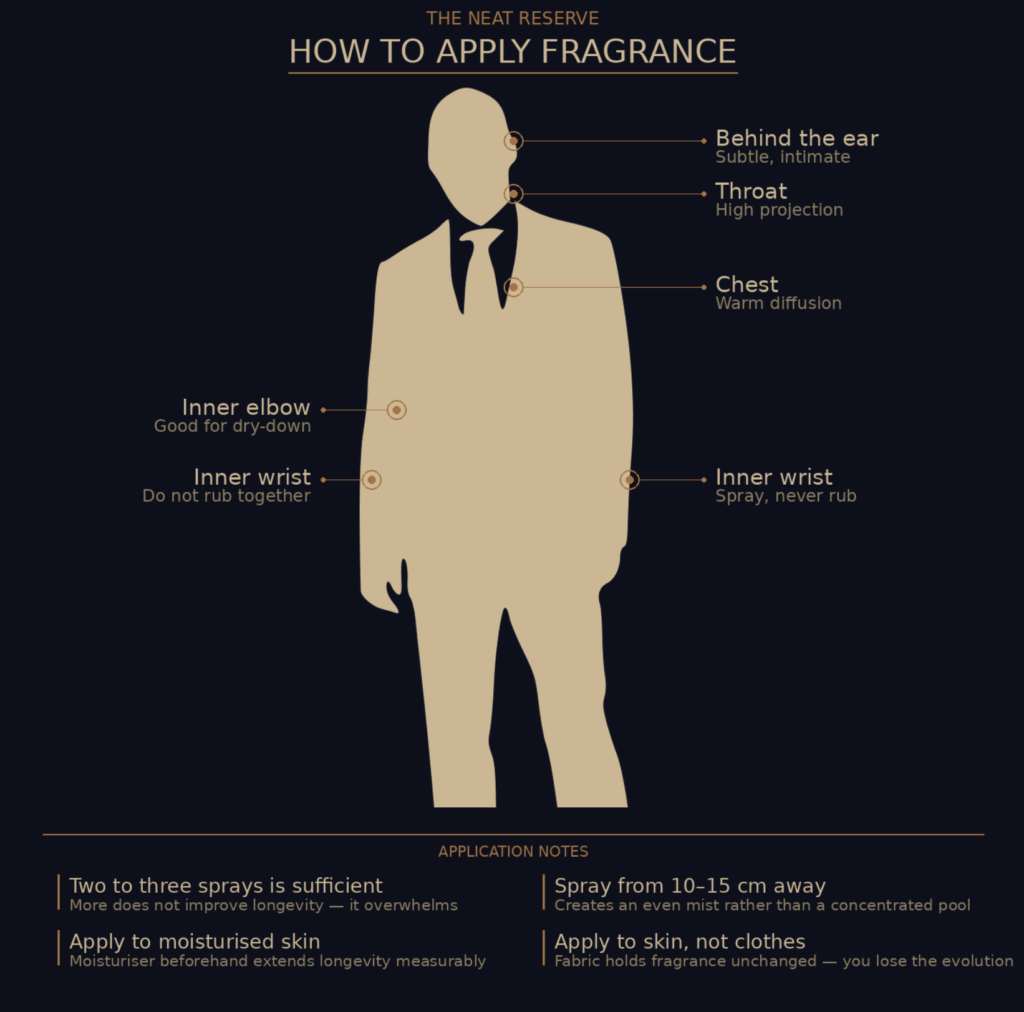
Apply to pulse points. The wrists, the inside of the elbows, the sides of the neck, the chest. These are areas where blood vessels run close to the surface. The warmth generated there diffuses fragrance steadily into the air around you rather than dumping it all at once.
Do not rub your wrists together after spraying. It is an almost universal habit and it is wrong. Rubbing crushes the molecular structure of the top notes and accelerates their disappearance. Spray and leave it alone.
Apply to skin, not clothes. Fabric holds fragrance for a long time but it holds it unchanged. You lose the entire evolution from top to base notes that makes wearing a fragrance interesting. Some formulations will also stain fabric permanently.
Two or three sprays is enough. Fragrance should be discovered by someone standing close to you, not announced to everyone in the room when you walk in. The men who over-apply almost always do it because they have become desensitised to their own scent. If you can smell yourself easily throughout the day, you are wearing too much.
Moisturise before applying. Dry skin absorbs fragrance quickly and holds it poorly. Unscented moisturiser applied beforehand gives the fragrance something to anchor to. The difference in longevity is noticeable.
Longevity and projection
These two words come up constantly in fragrance discussion and they are not the same thing.
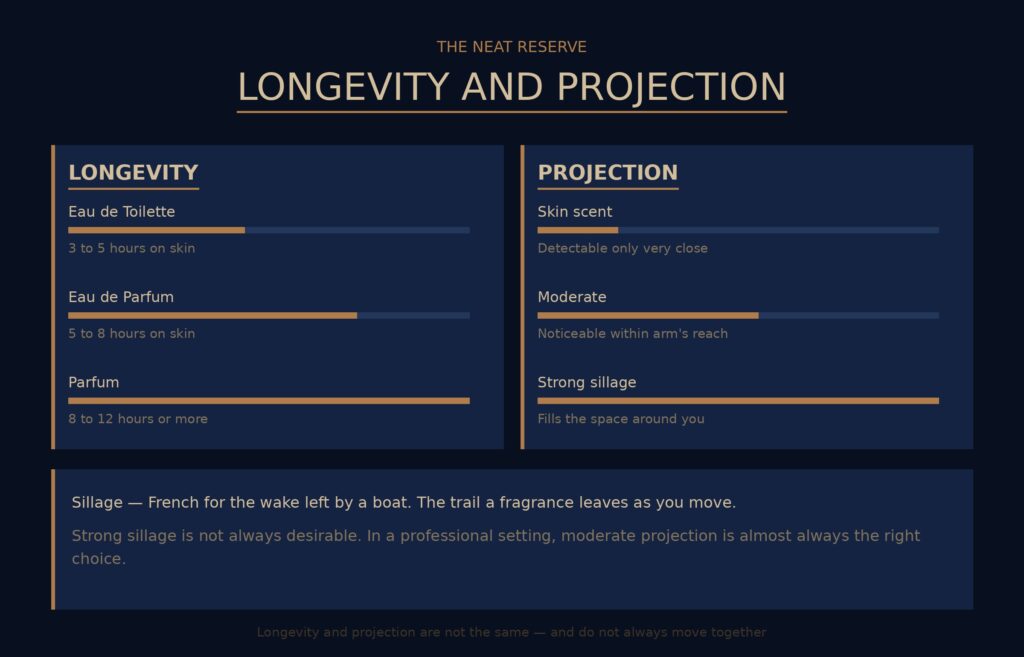
Longevity is how long a fragrance lasts on your skin. Projection, sometimes called sillage, a French word meaning the wake left by a boat, is how far the scent travels from your skin into the space around you. A fragrance can project strongly for the first two hours and then become a skin scent by the fourth. Another might project modestly all day but be detectable on your skin twelve hours after application. Neither is better. They suit different occasions.
In Australia, heat amplifies both projection and the speed at which top notes burn off. A fragrance lasting eight hours in a Melbourne winter might last four hours on a hot day in Brisbane. Heavy, resinous base notes tend to perform better in heat than light citrus-forward formulations, which can evaporate before you have even left the house.
Matching fragrance to season
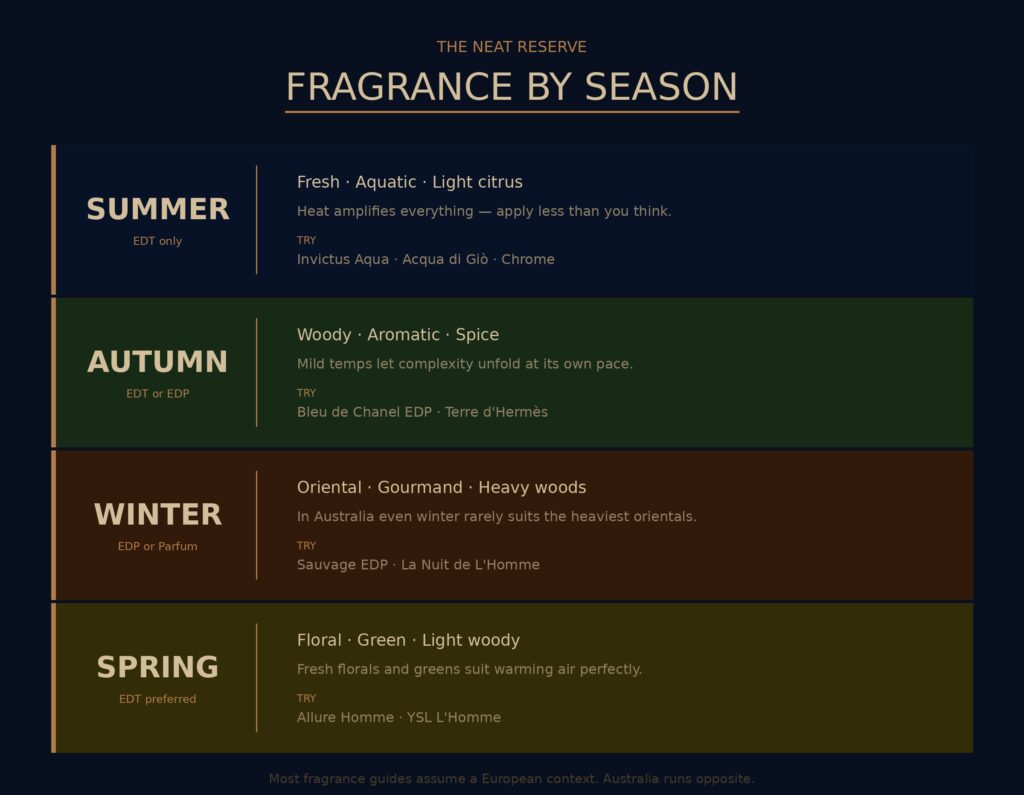
The general principle is simple. Heat amplifies, cold subdues. In summer, lighter fragrances project further and faster and require less application. In winter, heavier fragrances need the warmth of skin contact to diffuse properly.
For Australians this logic applies but with one important difference. Most fragrance guidance is written for a European or North American context where winters are genuinely cold. Even in a Melbourne July the temperature rarely drops low enough for the heaviest orientals to perform the way they were designed to. A fragrance built for a Scandinavian winter can still overwhelm on the coldest morning Sydney will produce. Lean toward the middle of the winter range rather than the extreme end. Save the truly dense, resinous fragrances for evenings out rather than all-day wear.
How to buy fragrance
The most expensive mistake in fragrance is buying based on top notes. The second most expensive is buying based on how something smells on someone else. Always test on skin. Spray once on your wrist, put the cap back and walk away. Come back in twenty minutes. Come back again in an hour. What you smell at sixty minutes is considerably closer to what you will actually wear. What you smelled at the counter is almost irrelevant. Test one fragrance per outing. Your nose fatigues faster than you expect. After two or three fragrances in a single session you can no longer accurately assess any of them.
Fragrance smells different on different people. The same base notes interact differently depending on skin pH, diet, body chemistry and dozens of other variables. A fragrance your best friend swears by might smell completely different on you. This is not a flaw in the fragrance. It is the reason fragrance is worth paying attention to.
Try samples before committing to a bottle. Decant services allow you to test a 5ml sample for a small fraction of the full bottle price. Testing a fragrance through a full day before buying is always worth doing, particularly at the EDP or Parfum level where the investment is significant. Buy from authorised retailers. Fragrance is one of the most counterfeited product categories in the world. If the price seems too good to be true it almost certainly is. In Australia, Myer, David Jones, Sephora and authorised brand boutiques are the safe options.
Building a wardrobe
One fragrance is a uniform. Three is a wardrobe. The tendency to accumulate bottles is real and understandable but it is worth resisting until you know what you actually like. Three well-chosen fragrances that serve different occasions will outperform a shelf of impulse purchases every time. A sensible starting point for most Australian men: A fresh daytime fragrance for work and warmer months. Something clean and versatile that works in an office and in heat. Invictus Aqua, Azzaro Chrome and YSL L’Homme are reliable entry points worth trying.
A signature fragrance with more character and complexity. Something that reflects your actual taste rather than what was recommended to you. This one takes time and testing to find and should not be rushed. A richer fragrance for evenings and occasions. Worn deliberately rather than daily. Bleu de Chanel EDP and Sauvage EDP are the obvious well-regarded options. Spending time with niche fragrance houses will eventually turn up something more personal.
The last word
Fragrance rewards patience and attention in equal measure. The man who understands what he is wearing and why, who tests properly before buying, who considers the season and the occasion, will wear better fragrance and spend less money doing it than the man who grabs whatever smells good under the shop lights. None of this requires expensive taste. It requires considered taste. Which, as it turns out, is considerably rarer.